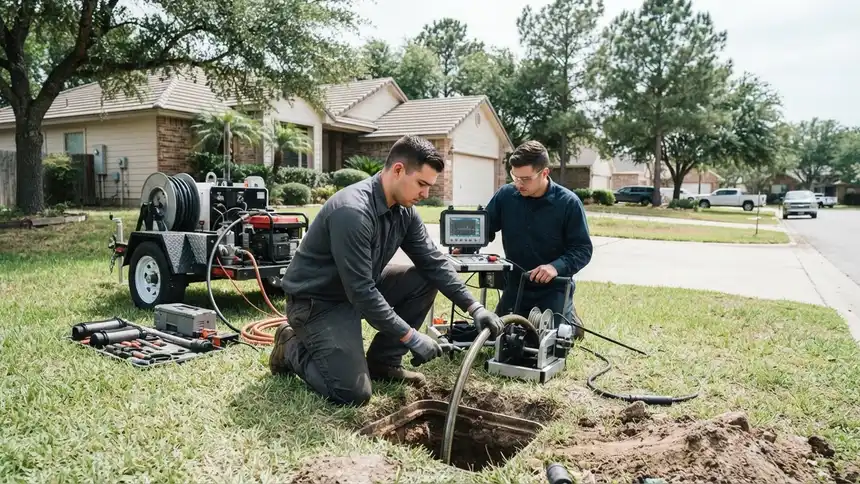
For a Meridian home with a structurally sound sewer pipe and localized cracks or root entry, trenchless repair is often the better fit; a collapsed, badly deformed, or repeatedly failing line usually needs replacement. The right choice depends on what a camera shows, how much of the pipe has failed, and whether the existing route and grade can still carry wastewater properly. We compare trenchless lining, pipe bursting, and conventional excavation so you can weigh cost, disruption, and long-term performance before work starts. The goal is a sewer line that drains reliably, not simply the least digging today.
Trenchless Sewer Line Repair vs. Replacement is a comparison of no-dig rehabilitation methods and installing a new sewer pipe when damage, age, or poor flow makes the existing line unreliable. In Meridian, our team starts with evidence from inside the pipe, then explains which methods can solve the actual defect.
How do you choose between trenchless repair and replacement?
Homeowners in Meridian choose trenchless repair when the sewer pipe still holds its shape and has defects a liner or localized repair can correct; replacement is better when the pipe has lost its structure or grade. A camera inspection should establish the material, diameter, defect location, and whether standing water or a blockage hides more serious damage.
For a cracked line with a stable, open bore, a cured-in-place pipe (CIPP) liner can create a new, continuous interior surface. If the line has a collapsed section, severe offset joints, or a low spot holding wastewater, lining the whole run may not correct the underlying geometry. New pipe installation can restore the route, diameter, and slope.
We serve local homeowners looking for Main Sewer Line Repair Meridian ID, and we base our recommendation on the inspection rather than the label "trenchless." A no-dig method is useful only if the existing pipe can support it and the finished line will drain as intended.
For a straightforward decision, compare these findings:
- Choose lining when the pipe is mostly intact, the damage is limited, and the line remains reasonably straight and properly graded.
- Consider pipe bursting when the old pipe needs full replacement but its route is usable and the surrounding soil allows the new pipe to be pulled into place.
- Choose open excavation when the pipe has collapsed, the route or slope must change, or access and soil conditions rule out trenchless equipment.
These are starting points, not a substitute for looking at the entire run. A single root opening at one joint differs from roots, fractures, and bellies spread across 40 feet of pipe.
What trenchless methods actually do
Trenchless sewer repair in Meridian uses access points to rehabilitate or replace buried pipe with less surface excavation than opening a continuous trench. The method matters: pipe lining strengthens the inside of a suitable existing pipe, while pipe bursting breaks apart the old pipe and draws a new one through its path.
Pipe lining: reinforce the existing route
With CIPP lining, a flexible resin-saturated liner is inserted through an access point, positioned across the damaged section, then cured against the pipe wall. The result is a hardened liner inside the original pipe. The process can seal cracks and some leaking joints, and it avoids digging up an entire lawn or driveway when the line remains structurally suitable.
Lining does not make a crushed pipe round again, lift a belly, or correct a bad slope. It also slightly reduces the pipe's inside diameter, so a proper design accounts for the existing size and expected flow. Our Sewer Pipe Lining Meridian ID work is most useful when inspection confirms that the line is open enough for the liner and does not need regrading.
Pipe bursting: replace the pipe from access points
Pipe bursting is a trenchless replacement method. A bursting head travels through the old pipe, fractures it outward, and pulls a new pipe into the space behind it. Contractors commonly need an entry pit and a receiving pit, but not a trench along the entire sewer route.
Bursting can replace a deteriorated line where lining is not enough, while preserving much of the surface above it. It needs room for pits and suitable soil conditions, and nearby utilities or tight bends can affect feasibility. If the line's route is wrong or a sag needs correction, bursting along the same route may simply reproduce the drainage problem.
Compare costs, disruption, and service life
For Meridian homeowners, trenchless repair generally costs less than extensive excavation when the pipe is a good candidate, but the final price depends on length, depth, access, pipe diameter, and repairs to landscaping or hardscape. Typical 2026 pricing in the area can range from roughly $3,000-$12,000 for a short or moderate lining job, $6,000-$20,000 for many pipe-bursting projects, and $4,000-$25,000 or more for open-trench replacement.
Those ranges are planning figures, not a quote: a long, deep line beneath a driveway or mature landscaping can exceed them, while a short, accessible repair can cost less. To compare sewer pipe repair and replacement fairly, ask what length is included, how access will be made, and whether the proposal addresses the cause of failure rather than only the visible symptom. We explain the price before work begins.
Repair and replacement also differ in how much of your property is disturbed. Lining can often be completed through existing cleanouts or small access excavations; bursting uses pits; conventional replacement opens a trench along some or all of the run. Excavation may require restoring paving, irrigation, lawn, or planting beds afterward.
Work time varies with access and complexity. A simple liner installation may take one working day, while replacement often takes one to three days, excluding unusual utility conflicts or extensive restoration. Ask how long the sewer service will be interrupted and whether temporary arrangements are needed.
Expected life is another part of the cost difference between trenchless repair and replacement in Meridian. Properly installed CIPP liners are commonly described with service-life expectations of about 50 years, though actual performance depends on materials, installation, and use. New pipe also offers decades of service when installed at the correct grade and protected from damage. Warranties and product specifications should be considered alongside the method-not treated as a substitute for a sound installation.
When should a sewer line be replaced instead of repaired?
A Meridian sewer line should be replaced instead of repaired when it is collapsed, badly deformed, extensively fractured, or too poorly graded to drain reliably. Replacement is also a stronger choice when defects occur throughout the run, repeated spot repairs have not held, or the pipe material has deteriorated beyond a practical lining candidate.
Age alone does not decide the job. Older homes may have clay, cast-iron, or other legacy pipe, but condition varies with installation, soil movement, roots, and maintenance. A camera can reveal separated joints, corrosion, scale, fractures, root intrusion, or a belly; the technician should also note distance and clock position so the defect can be located from the surface.
In older parts of town, varied pipe ages and mature landscaping make inspection especially useful before digging. We see that context in Main Sewer Line Repair in Old Town Meridian, where preserving a driveway or established yard may matter-but not at the expense of leaving a structurally failed line in place.
Replacement is worth discussing when inspection shows one or more of these conditions:
- A camera cannot pass because the pipe has caved in or its shape has narrowed severely.
- Multiple cracks, offsets, or failed joints are distributed across a long section.
- Standing water remains in a belly, and the line needs excavation to reset its slope.
- The sewer backs up repeatedly after clearing, and inspection finds defects that cleaning cannot fix.
If one short section has failed while the rest of the pipe remains sound, a localized excavation and repair may be more sensible than replacing the entire line. The inspection report and a clear discussion of trade-offs help distinguish that case from a line that is failing in several places.
Common mistakes that lead to the wrong sewer decision
Homeowners in Meridian can choose the wrong sewer method if they rely on symptoms alone or assume "trenchless" means the pipe needs no excavation. Slow drains and sewage odors are clues, but they do not reveal whether the cause is a blockage, root entry, broken pipe, or a low section.
One common mistake is approving a liner before confirming the pipe's shape and grade. A liner can seal a suitable pipe, but it cannot restore a collapsed passage or eliminate a belly where solids collect. Another is treating every root problem as proof that the whole line must be replaced: roots often enter through a joint or crack, and the camera shows whether damage is localized or widespread.
Do not compare proposals by the word "trenchless" alone. Check whether the scope describes lining or bursting, the length of pipe, access pits, cleanout work, and surface restoration. A new pipe installed with the wrong slope can still back up; a liner installed in a structurally unsuitable pipe can fail to solve the problem.
Finally, do not keep using chemical drain cleaners to manage recurring main-line symptoms. They do not repair a broken sewer pipe and can damage plumbing materials. If multiple fixtures gurgle or wastewater returns at a floor drain, reduce water use until the line has been assessed.
When to call a professional in Meridian
Meridian homeowners should call a sewer professional when more than one fixture backs up, a cleanout spills, or a recurring clog returns soon after clearing. Wastewater surfacing in a yard, persistent sewer odor, or a visible depression along the route also deserves prompt attention.
We use a sewer camera to identify the defect and map its position, then match the repair to what the pipe can support. Our team can explain Meridian trenchless plumbing options, including lining and bursting, alongside conventional replacement when excavation is the sounder fix. If the pipe is actively backing up, avoid running washers, dishwashers, and other high-volume fixtures until the line is cleared and checked.
Prompt diagnosis matters because untreated wastewater can damage floors, soil, and landscaping. In cold weather, exposed or shallow sections and wet ground also make the source harder to judge by sight alone; the camera provides evidence inside the pipe. We work to give you a practical repair plan and explain the likely disruption before the work starts.
Frequently Asked Questions
Is trenchless sewer repair better than replacement?
Trenchless repair is better when the existing pipe is open, stable, and suitable for lining; replacement is better for collapse, major deformation, or bad grade. Lining can avoid a long trench and reduce surface restoration, but it cannot correct every structural problem. The camera findings-not the method's label-determine which option offers a durable fix.
When should a sewer line be replaced instead of repaired?
Replace a sewer line when it is collapsed, extensively damaged, repeatedly failing, or unable to drain because of its shape or slope. A short, isolated crack may need only a targeted repair. A camera inspection of the full accessible run helps show whether defects are limited or spread across the line.
What is the difference between pipe lining and pipe bursting?
Pipe lining installs a cured liner inside a suitable existing pipe, while pipe bursting fractures the old pipe outward and pulls a new pipe through its route. Lining rehabilitates the interior; bursting replaces the pipe. Both reduce the need for a continuous trench, but bursting usually requires entry and receiving pits.
Does trenchless sewer work for a collapsed pipe?
A fully collapsed sewer pipe usually needs excavation or another replacement approach because a liner cannot pass through or restore the crushed section. Pipe bursting may work in some conditions, but access, soil, route, and utility locations affect feasibility. A camera inspection and site assessment determine the practical method.
How do I choose the right sewer line option for my home?
Choose based on a camera inspection, defect locations, pipe condition, grade, access, and the surface restoration each method requires. Ask whether the recommendation is lining, bursting, localized repair, or open replacement and what evidence supports it. For a long line or extensive damage, compare the full scope and expected disruption-not only the starting price.
Get help with Main Sewer Line Repair in Meridian
If you are weighing whether to reline or replace a sewer line, Sewer Plumbing Pros can inspect the pipe and walk you through the practical options for your Meridian home. Call 208-568-8003 to arrange help with your main sewer line.